
Stop running your floor on yesterday’s data
Navisiontech configures Microsoft Dynamics 365 Business Central for mid-market manufacturers, so what the floor reports, what the warehouse counts, and what finance posts are the same numbers, updated in something close to real time.
We’re the right call when you’re too big for QuickBooks Manufacturing and too small to absorb an SAP implementation.


The configuration that makes the difference
Business Central is a generic ERP out of the box. Manufacturing happens in six specific places. Here is how Navisiontech configures each one for mid-market plants.
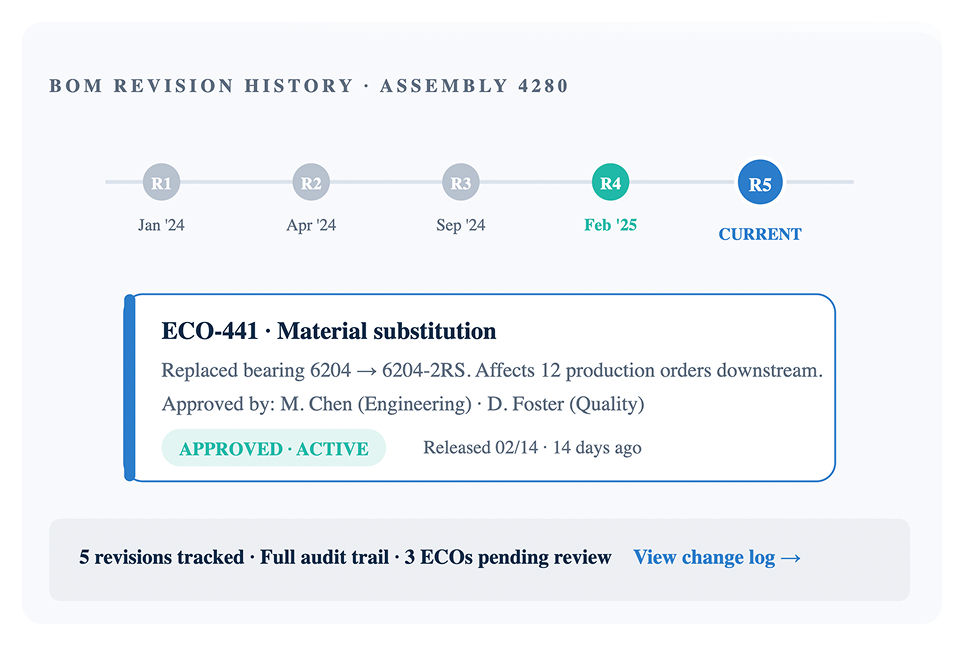
Product data that doesn’t lie
If your BOM is wrong, everything downstream is wrong. Wrong picks. Wrong costs. Wrong promises to customers. Most mid-market plants we walk into have at least one BOM that nobody wants to touch, because the consequences of changing it are unpredictable.
We configure Business Central so BOMs are version-controlled, engineering changes flow through approval before they’re released, and the floor and the design team stop maintaining different versions of the same product.
 Multi-level structures with version history
Attributes for configurable
items
Routings linked to work centers and resources
Engineering change orders with approval routing
The floor that reports itself, not at end of shift
Shop floor reporting that happens at end of shift, or worse, end of week, isn’t wrong. It’s late. The data tells you what already happened, when there’s nothing left to do about it. Supervisors stop trusting reports because reports describe yesterday’s problems.
Navisiontech connects Business Central to your floor through Insight Works, MES integrations, and barcoded job tickets, so the question “where are we on order 4821?” has an answer that’s less than five minutes old.
Production order start/stop reporting from the floor
Scrap and yield logged where they happen
Labor time capture at the operation level
Machine status and downtime tracking


Inventory you can actually dispatch from
There’s accurate, and there’s accurate enough to dispatch a truck on. Most ERPs are the first kind. They look right at month-end. But during the day, the count on screen and the box on the rack disagree often enough that promises to customers become hedged.
We configure inventory with bin-level discipline, lot and serial where regulation demands it, and cycle counting that runs as part of the workflow, not as a project. Dispatch and customer service start quoting with confidence, not faith.
Multi-location and bin-level tracking
Cycle counting integrated with daily workflow
Lot, serial, and expiration when regulation demands
WIP visibility across the production line
Quality that holds up to an audit
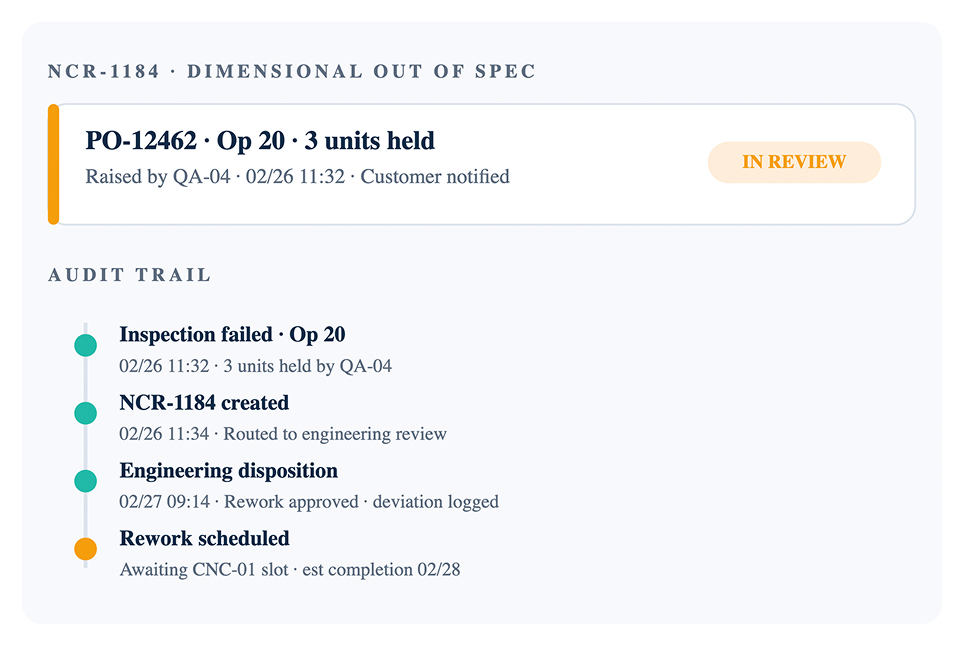
Quality systems built on email threads and spreadsheets fail at the worst possible moment, when a regulator or a major customer asks for evidence. The information exists. It’s just scattered across a dozen places no one is responsible for keeping current.
We configure Business Central with inspection workflows at receiving, in-process, and at finish; nonconformance tracking with disposition routing; and an audit trail that doesn’t have to be reconstructed. The difference is between “we think it was caught” and “here is the record.”
Inspection at receipt, in-process, and final
Hold, release, and rework controls
Nonconformance reports with disposition workflow
Audit trail across receivers, NCRs, dispositions

Costs that are right today, not next month
Standard costing is useful only when actuals roll up fast enough to compare. Most of the variance pain we see at mid-market manufacturers comes from costs that aren’t computed until weeks after the fact: labor that wasn’t reconciled, scrap that wasn’t captured, overheads applied with a lag.
We configure Business Central so actual costs accumulate at the operation level as work happens. The variance you find at month-end becomes small enough to interrogate, not catastrophic enough to write off.
Standard cost rollups for material, labor, overhead
Variance analysis by material, labor, scrap
Actual cost capture at the operation level
Customer and product margin visibility
Costs that are right today, not next month
Standard costing is useful only when actuals roll up fast enough to compare. Most of the variance pain we see at mid-market manufacturers comes from costs that aren’t computed until weeks after the fact: labor that wasn’t reconciled, scrap that wasn’t captured, overheads applied with a lag.
We configure Business Central so actual costs accumulate at the operation level as work happens. The variance you find at month-end becomes small enough to interrogate, not catastrophic enough to write off.
Standard cost rollups for material, labor, overhead
Variance analysis by material, labor, scrap
Actual cost capture at the operation level
Customer and product margin visibility

When production and finance share one database
These aren’t predictions. They’re outcomes we’ve watched repeat across mid-market manufacturing implementations.


What changed
The situation in 2020
Finance was closing the books on the 8th business day of the month, and nobody trusted the numbers. Pricing for the largest automotive customer lived in a 14-tab Excel workbook that one person maintained. Quality data ran on a separate platform that didn’t talk to the ERP. EDI chargebacks averaged $2,400 per month. Inventory accuracy was 87% at month-end and lower during the day. Operations and finance had stopped arguing about whose numbers were right because they had both given up on agreement.
What we did
Navisiontech ran a four-week plant walk across all three sites and proposed a ten-month phased implementation. Finance and inventory went live in month four. Production and quality joined in month seven. Warehouse mobility and EDI followed in month ten. Each phase had a six-week stabilization window before the next one started.
The stack we deployed
Business Central Premium as the core. Insight Works for shop floor reporting and license plates. Tasklet Mobile WMS for receiving, picking, and counting. Lanham EDI for the automotive customer’s 850/855/856/810 documents. Power BI for finance and operations dashboards. EasyEFT for the small B2B card-not-present volume.
Where AI helps a manufacturer, and where it doesn’t
AI is currently being sold as a solution to every manufacturing problem. It isn’t. For a handful of specific, well-bounded problems, it’s genuinely useful, once your data is clean enough to feed it. Here’s how we sort that with clients.


How Pricing Works
① Discovery Assessment ($20,000 Fixed Fee) → ② Fixed-Price Proposal → ③ Foundation | Connected | Complex


Who you’ll actually work with
ERP implementations are people projects with software underneath. Here is the structure of the team you’d meet on a Navisiontech engagement, and what each role is accountable for from day one through the years after go-live.
REAL STORIES. REAL RESULTS. REAL GROWTH.
Trusted by distributors across the U.S.
Trusted by businesses across the U.S.




Stay Connected