Wholesale Distribution2026-07-27T16:24:10+00:00

Stop running your warehouse on yesterday’s count

Navisiontech configures Microsoft Dynamics 365 Business Central for mid-market wholesale distributors, so what you have on the shelf, what you have promised to customers, and what you can ship today are the same number, updated in something close to real time.

We’re the right call when you’re too big for QuickBooks Wholesale and too small to absorb an SAP implementation.

Speak to an expert
Free ERP assessment

Most distribution ERP failures aren’t technology failures. They’re promise-to-shelf failures.

Sales quotes from yesterday’s inventory snapshot. Warehouse counts that don’t match the system. Customer-specific pricing maintained in three places. Backorders that nobody told the customer about. The numbers in your ERP and the boxes on your shelves stop agreeing.

That gap is what we close. Navisiontech configures Business Central so that what sales quotes, what the warehouse picks, and what finance posts are the same numbers, updated in something close to real time.

easyeft

Accept cards faster. Lower your rates. Get paid on time — right from Microsoft Business Central. So you can focus on growing your business.

background

The configuration that makes the difference

Business Central is a generic ERP out of the box. Distribution happens in seven specific places. Here is how Navisiontech configures each one for mid-market distributors.

Business Central Wholesale Distribution

Inventory you can actually sell from

If your inventory count is wrong, everything downstream is wrong. Wrong promises to customers. Wrong replenishment orders. Wrong stockout alerts. Most mid-market distributors we walk into have an “official” inventory count and a “real” inventory count, and the gap between them fills the expediting time of three people every week.

We configure Business Central with bin-level accuracy, lot and serial discipline where regulation demands it, and cycle counting that runs inside the daily workflow. Customer service stops hedging on availability. Sales stops promising stock that isn’t there.

✅ Bin-level accuracy across multiple warehouses

✅ Cycle counting integrated into daily workflow

✅ Lot, serial, and expiration tracking

✅ Real-time visibility across all locations

The time between order and truck

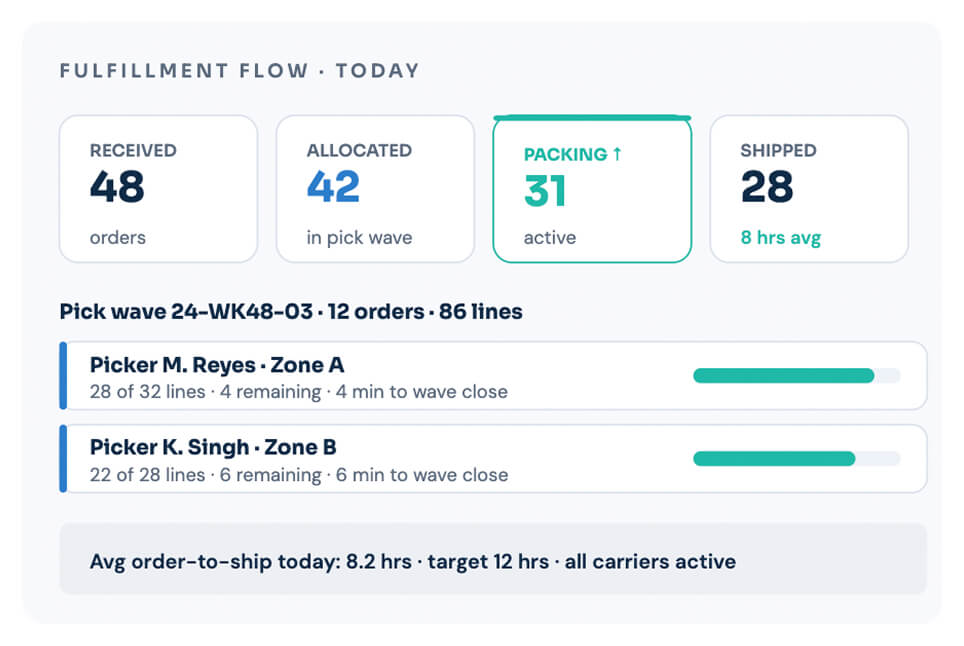
The number of hours between an order arriving and a truck leaving the dock is the single metric that decides if your customers keep buying from you. Cut it in half and you keep customers you would have lost. Add a day and you lose customers you would have kept.

The configuration of pick paths, batch and wave logic, packaging rules, and carrier selection drives that number more than any other thing. We tune all of it together, not as separate projects.

✅Wave and batch picking optimization

✅ Auto-packaging suggestions by SKU

✅Mobile pick and pack on handhelds (Tasklet)

✅ Carrier rate shopping at the pack station
Business Central Wholesale Distribution

Pricing that holds up under a phone call

Customer A pays list. Customer B pays contract. Customer C gets a 12% override on certain SKUs from Tuesday through Friday because of a promotion that started in 2019. Your salespeople need to know the right price in the moment, every time. If pricing logic lives in spreadsheets and tribal knowledge, salespeople hedge and customers get inconsistent quotes.

We configure Business Central so list, contract, volume tier, and promo pricing all flow through the same waterfall, and your team quotes with confidence instead of guessing.

✅ Customer pricing groups and contracts

✅ Trade promotions with date ranges and SKU lists

✅ Volume tier pricing with effective dates

✅ Override approval workflows over a threshold

Orders that arrive five different ways

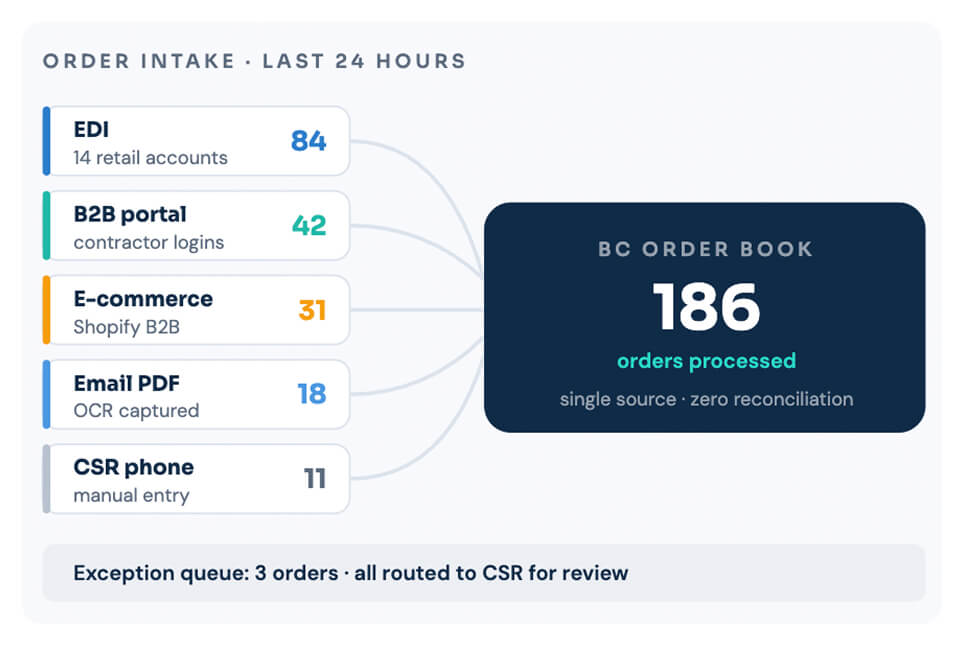
EDI from your major retail accounts. A B2B portal you built three years ago. An e-commerce site. Email PDFs from smaller customers. And the phone. If each channel writes to a different system, your fulfillment team is reconciling instead of fulfilling.

We configure Business Central so every channel writes to one order book, with channel-specific routing, validation, and exception handling. The team stops asking “which system has this order” and starts asking “when can we ship it.”

✅ EDI for major retailer and OEM accounts (Lanham)

✅ E-commerce integration (Shopify, BigCommerce, Magento)

✅CSR order entry with live availability

✅ B2B portal sync

✅ Email-PDF order capture with OCR

Business Central Wholesale Distribution

Replenishment that doesn’t surprise you

Stocking the right products at the right warehouses is a math problem dressed up as an art. Distributors who get it right have lower working capital and higher service levels. Distributors who get it wrong are paying interest on inventory that won’t sell, and stocking out of items that would have.

We configure forecasting at the SKU and warehouse level with seasonality, customer-specific lead times, and supplier reliability factors baked into the math. Replenishment suggestions feed straight into your purchasing workflow.

✅ SKU and warehouse-level forecasting

✅ Supplier lead time tracking

✅ Min/max with safety stock optimization

✅ Replenishment suggestions feeding straight to POs

Returns that stop being a black hole

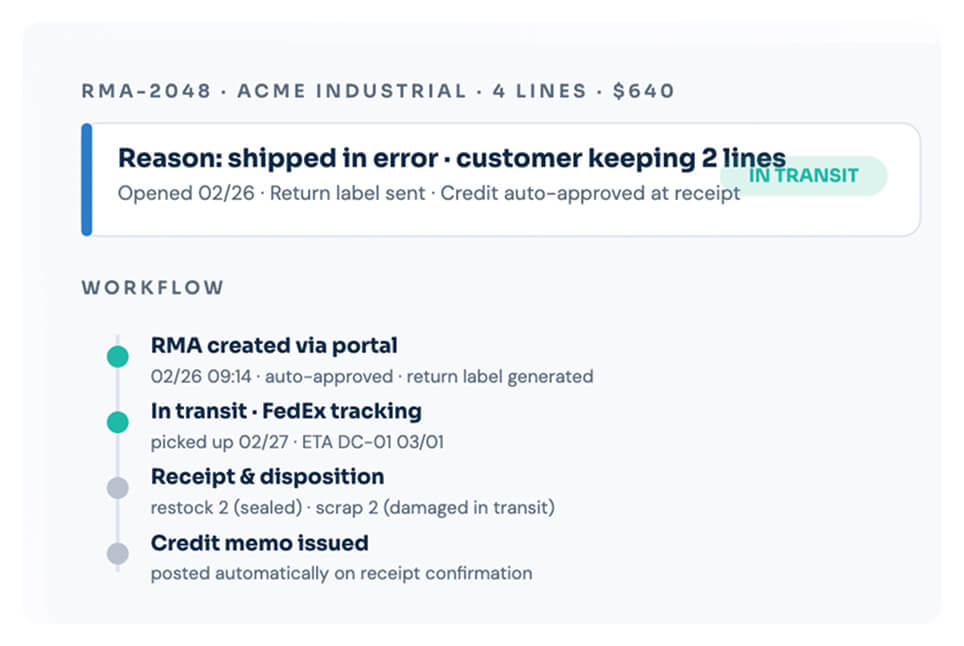
Returns are the part of the business everyone hopes won’t happen and nobody designs the system for. Then they’re 8% of revenue and a complete mystery to finance. Inventory in disposition limbo. Credits issued late. Customers asking where their refund is.

We configure RMA workflows with disposition rules (restock, refurbish, scrap, return-to-vendor), automated credit memos, and reverse logistics tracking. Returns become a process, not a fire drill.

✅ RMA creation from any channel

✅ Credit memo automation

✅ Disposition rules by product and reason

✅ Reverse logistics carrier integration

Business Central Wholesale Distribution

Freight that stops bleeding margin

Freight is the line item most often surprised by at month-end and most often handed off to a 3PL who doesn’t optimize for you. Carrier rates change weekly. Service levels are mismatched to customer SLAs. Accessorials show up on the invoice you didn’t expect.

We configure Business Central to compare carriers at pack time, suggest the cheapest option that meets the customer’s service level, accrue freight cost on every shipment, and reconcile to carrier invoices automatically. Freight stops being a black box and becomes a real cost lever.

✅ Carrier rate shopping at pack station

✅ Freight cost accrual per shipment

✅ LTL and 3PL portal integrations

✅ Service level vs cost trade-off rules

✅ Carrier invoice reconciliation

When sales, warehouse, and finance share one database

These aren’t predictions. They’re outcomes we’ve watched repeat across mid-market distribution implementations.

01

Customer service stops hedging on availability

When the inventory count on screen matches what’s on the shelf, customer service quotes ship dates without disclaimers. The phrase “let me check with the warehouse” disappears from the call script.

02

Backorders stop surprising customers

Real-time availability means promises get made with current data, not yesterday’s snapshot. When something is going to be short, the customer hears about it from you, not from the missing box.

03

Fewer chargebacks from major accounts

EDI document accuracy, on-time shipping rates, and label compliance all improve when the system actually controls them. The monthly chargeback line item shrinks to a fraction of what it was.

04

Freight margin stops bleeding

Carrier rate shopping at pack time turns a finance pain point into a real cost lever. The savings show up in the P&L every month, not just at contract renewal.

05

Returns stop being a black hole

RMA workflows with disposition rules mean returns get processed in days, not weeks. Credit memos post automatically. Inventory in disposition limbo stops piling up in a corner of the DC.

06

Sales reps quote with confidence

The most underrated outcome. When customer-specific pricing, contract terms, and stock availability live in one place that everyone trusts, sales stops hedging and starts closing.

A Real Engagement

What this actually looks like in practice

Anonymized case study from a recent multi-site discrete manufacturing client. Numbers are real. The name isn’t.

Industrial MRO distributor

Four DCs. Three states. ~$80M revenue. Migrating off a legacy on-prem ERP.

3 years post go-live

What changed

The situation in 2021

Orders arrived through five channels and got rekeyed into the ERP by hand. Inventory accuracy ran around 84%, low enough that sales reps stopped trusting on-hand numbers and started “calling the warehouse” before quoting. Freight chargebacks from the largest OEM customer averaged $4,200 a month for label and ASN violations. Returns sat in a corner of DC-01 for an average of 14 days before a credit memo was issued. Customer-specific pricing lived in three places that didn’t agree.

What we did

Navisiontech ran a three-week DC walk across all four sites and proposed a nine-month phased implementation. Finance, inventory, and the order book went live in month three. EDI and the B2B portal joined in month five. Warehouse mobility, carrier rate shopping, and the RMA workflow followed in month eight. A two-month stabilization window separated each phase.

The stack we deployed

Business Central Premium as the core. Tasklet Mobile WMS for receiving, picking, packing, and counting. Lanham EDI for the OEM customer’s 850/855/856/810/940/945 documents. Insight Works for warehouse productivity and license plates. Power BI for the sales and operations dashboards. Carrier rate shopping integrated at the pack station. EasyEFT for card-not-present B2B payments.

What changed

Order-to-ship cycle
36 hours → 8 hours
Inventory accuracy
84% → 99.4%
EDI chargebacks (avg / month)
$4,200 $880
Returns processing time
14 days 3 days
CSR team size (same volume)
11 people 7 people

“Three weeks after we went live, the sales team stopped checking with the warehouse before they quoted. Six months in, the warehouse stopped checking with the system before they picked. That’s when we knew it had taken.”

Director of Operations, Industrial MRO Distributor

Where AI helps a distributor, and where it doesn’t

AI is currently being sold as a solution to every distribution problem. It isn’t. For a handful of specific, well-bounded problems, it’s genuinely useful, once your data is clean enough to feed it. Here’s how we sort that with clients.

Works today

Distribution problems where AI earns its keep right now

These use cases have a tight problem definition, a clean data source, and an action a human can take from the output. They’re operational at Navisiontech clients today.

• Demand forecasting at SKU and warehouse level
Pattern detection that beats moving averages, accounting for seasonality, customer mix shifts, and supplier lead times.

Customer churn signals from order pattern shifts
Earlier warning when a major account’s ordering rhythm changes. A weekly buyer who suddenly skips two cycles is information.

Slow-moving and obsolete inventory identification
Surfacing SKUs that should be discontinued, marked down, or returned to vendor, before they tie up another quarter of working capital.

Carrier rate and freight anomaly detection
Flagging carrier invoices that don’t match shipment manifests, or rate increases that violate negotiated terms.

Natural-language queries against operational data
“Show me orders shipped late to top-20 customers in the last 30 days.” No report builder required.

Works today

Where we tell clients to slow down

These pitches are getting louder, but the underlying tech, data, or organizational readiness usually isn’t there yet. We’d rather under-promise.

Autonomous replenishment without human approval

Math is good. Supplier relationships are not yet AI-managed. Buyer judgment about supplier behavior still beats the model.

AI-only pricing optimization

Distribution pricing is a customer relationship, not just a math problem. Use AI to surface anomalies; let humans set policy.

Replacing experienced buyers with optimization engines

Buying is partly math and largely judgment about which supplier is about to disappoint you. Tools assist; they don’t replace.

“AI route optimization” without truck sensor data

It’s a telemetry problem first, an AI problem second. Get GPS, dwell, and load data flowing before buying anything labeled “optimized.”

A Real Engagement

Six distribution shapes we know how to set up

These are the actual profiles of mid-market distributors we’ve implemented Business Central for. If one looks like the mirror, the conversation gets specific quickly.

01

Profile 01

Industrial MRO distribution

High SKU count, broad assortment, regional customer base. Contractor and plant maintenance buyers who need stock today, not next week. Will-call counters, drop-ship vendors, and field-tech accounts all hitting the same inventory.

Typical setup
BC + Tasklet WMS + Insight Works + Power BI + B2B portal

01

Profile 02

Food service distribution

Perishables. Lot trace and expiration dating are non-negotiable. Temperature-controlled storage and transit. Route delivery with multi-stop trucks. Catch-weight on protein and produce. FSMA recall readiness.

Typical setup
BC + lot trace + catch-weight + route delivery + Tasklet

03

Profile 03

Building products & construction supply

Heavy, bulky, and often awkward to ship. Job-site delivery scheduling. Will-call counter with daily walk-ins. Contractor accounts with project pricing. LTL freight quoting baked into the order flow.

Typical setup
BC + job/project orders + LTL integration + will-call workflow

04

Profile 04

Medical & pharmaceutical distribution

DEA and FDA regulation. Lot, serial, and expiration on every line. Recall readiness that gets tested. Validated processes, signed change controls, and an audit trail that auditors will actually read. 21 CFR Part 11 considerations.

Typical setup
BC + lot/serial + validated processes + document control

05

Profile 05

Electrical, HVAC & plumbing supply

Contractor customers with deeply negotiated contract pricing. Project orders that stretch over weeks. Counter sales by the same customers buying from a contract account. Branch-level inventory across many small locations.

Typical setup
BC + contract pricing + multi-branch + counter sales + project orders

06

Profile 06

Apparel, footwear & consumer goods

Seasonal buys. EDI-heavy with major retail customers. High returns volume. Retail compliance is the difference between profit and chargeback. Size and color matrix on every SKU. Drop-ship from vendor to end customer common.

Typical setup
BC + Lanham EDI + matrix items + retail compliance + RMA

The Integration Ecosystem

What BC reads from and writes to in your stack

Business Central rarely runs alone. It connects to the purchasing, warehouse, sales, and finance tools your team already uses. Every integration on this page is one Navisiontech has deployed at least once. None of it is theoretical.

icon
Purchasing & Procurement

Supplier portals, VMI, and three-way match

Supplier EDI• Vendor managed inventory • Three-way match • Approved supplier list • SAP Ariba • Coupa • Supplier scorecards

Purchase orders, advance ship notices, invoices, and supplier performance data flow into BC. Three-way match runs at receipt. Supplier-managed inventory programs link directly to your replenishment workflow.

icon
Warehouse & Fulfillment

WMS, mobile, and warehouse automation

Tasklet Mobile • WMS • Insight Works • Zebra RF scanners • Honeywell handhelds • Cipher Lab • Sortation systemsCubiscan

Receiving, putaway, picking, packing, and cycle counting on handhelds. License plates that follow inventory from dock-in to dock-out. Real-time sync to BC, not batched at end of shift.

icon
Trading Partners & EDI

EDI, retail compliance, and customer integration

Lanham EDI • TrueCommerce • SPS Commerce • Retail routing guides • GS1 labels • ASN compliance • Chargeback management

Documents 850, 855, 856, 810, 940, 945, 997 with major retail, OEM, and B2B customers. Routing guide compliance baked in. ASN accuracy that holds up to a chargeback audit.

icon
Sales, B2B & E-commerce

CRM, portals, and online stores

Dynamics 365 Sales • Salesforce • HubSpot • Shopify B2B • BigCommerce • Magento • Custom B2B portals

Customer accounts, contract pricing, opportunities, and online orders all flow into BC. Sales reps quote from one pricing engine. Customers self-serve through the portal with the same data the CSR sees.

icon
Logistics & Carriers

Carriers, 3PL, and rate shopping

UPS • FedEx • USPS • LTL carriers • 3PL portals • ShipStation • Rate shopping engines • Freight audit

Real-time rate quotes at pack station. Service level matched to customer SLA. Manifests, tracking, and freight cost accrual flow into BC. Carrier invoices reconcile automatically.

icon
Banking, Tax & Payments

Payments, tax engines, and bank feeds

EasyEFT • ChargeLogic • Authorize.Net • Avalara • Vertex • ACH bank feeds • Microsoft 365

Card-not-present and ACH payments inside BC. Sales tax computed correctly across multi-state distribution. Bank reconciliation via direct feed. Outlook and Teams approvals route natively.

X

How we actually build the connections

Microsoft Power Platform (Power Automate, Dataverse) for low-code connections. BC’s REST API and webhooks for moderate complexity. Custom AL extensions inside BC for deep functional integration. We pick the right approach per connection, not a single framework forced on everything.

What does this typically cost?

Most ERP partner pages avoid pricing because every situation is different. That’s true. But distributors shopping for a partner deserve to know if they’re in the right zip code before they invest hours in a sales conversation. Here is how implementations actually land at Navisiontech, in real ranges.

ESTIMATED INVESTMENT RANGES

How Pricing Works

Discovery Assessment ($20,000 Fixed Fee) Fixed-Price Proposal Core | Essential | Advanced

Core

Predefined Project Plan. Acceptance Testing. Go-Live Support. 1 Production Environment & 3 Sandboxes

Typical Implementation Investment

$20K to 30k

Implementation, fixed scope

Timeline 3 weeks

Training

  • Self-paced

Accounting/Finance

  • Basic Accounting
  • One Posting Group Combination
  • Out of the box Financial Reports
  • Sales Tax Handling in one jurisdiction

Purchase

  • Self-guided setup

Security 

  • Self-guided Setup

Essential

Predefined Project Plan. Acceptance Testing. Go-Live Support. 1 Production Environment & 3 Sandboxes

Typical Implementation Investment

$50k to 75k

Implementation, scope-banded

Timeline 2 to 4 months

Training

  • Guided Training (Two 4 hours session)
  • Requisition Worksheet Workshop
  • Stockkeeping Units Workshop

Accounting/Finance

  • Basic Accounting
  • Up to 3 Posting Group Combinations
  • 2 Financial Dimensions (KPI)
  • Balance Sheet & Income Statement with 2 different column layouts
  • Sales Tax Handling in up to 3 Jurisdictions
  • Start with Beginning GL Balances

Purchase

  • Pricing and discounts workshop
  • Manage vendors payment term
  • Start with Beginning AP Balances
  • Migrate Vendor Records

Sales

  • Pricing and discounts workshop
  • Manage customers payment terms
  • Start with Beginning AR Balances
  • Migrate Customer Records (ship to address)

Inventory

  • Migrate Up to 2K SKUs
  • Variants with up to 2 frameworks
  • 3 Inventory Locations
  • Beginning Balances
  • up to 3 item charges

WMS

  • Mobile WMS
  • Standard WMS

Supply Chain

  • Eship Packing
  • Choose 1 carrier
  • Up to 5 packing stations
  • 3rd Party Shipping accounts
  • Ship to address

Reporting

  • up to 3 Custom Document type reports (such as Sales Order, Invoice, Purchase Order, etc.)
  • Performance Dashboard (Power BI License required)

Security 

  • Guided Permissions Setup
  • Up to 3 User Groups
  • Guided Change Log Setup

Advanced

Predefined Project Plan. Acceptance Testing. Go-Live Support. 1 Production Environment & 3 Sandboxes

Typical Implementation Investment

$75k to 125k

Implementation, banded with contingency

Timeline 6 to 8 months

Training

  • Guided Training (Two 4 hours session)
  • Requisition Worksheet Workshop
  • Stockkeeping Units Workshop

Accounting/Finance

  • Advanced Accounting
  • Up to 6 Posting Group Combinations
  • 6 Financial Dimensions (KPI)
  • Balance Sheet & Income Statement with 2 different column layouts
  • Sales Tax Handling in up to 10 Jurisdictions
  • Start with 1 years’ worth of monthly GL Balances

Purchase

  • Pricing and discounts workshop
  • Manage vendors payment term
  • Start with Beginning AP Balances
  • Migrate Existing Purchase Orders
  • Migrate Vendor Records

Sales

  • Pricing and discounts workshop
  • Manage finance charges
  • Manage customers payment terms
  • Start with Beginning AR Balances
  • Migrate Existing Sales Orders
  • Migrate Customer Records (ship to address)
  • Includes credit card processing setup

Inventory

  • Migrate Unlimited SKUs
  • Advanced Variants with unlimited frameworks
  • 10 inventory locations
  • Beginning Balances
  • up to 5 item charges

WMS

  • Mobile WMS
  • Advanced WMS

Supply Chain

  • Eship Packing
  • Get UPS, Fedex or USPS Shipping
  • Up to 10 packing stations
  • 3rd Party Shipping accounts
  • Ship to address

Reporting

  • Up to 5 Custom Document type reports (such as Sales Order, Invoice, Purchase Order, etc.)
  • Performance Dashboard (Power BI License required)

Security 

  • Guided Permissions Setup
  • Up to 6 User Groups
  • Guided Change Log Setup
  • One-Click Change Log Access
How an Engagement Runs

Specific about timeline.
Specific about cost

Most ERP partner pages are vague about phasing because vagueness keeps options open. We’d rather be specific and lose the engagements that aren’t a fit. Here is how a typical distribution project runs at Navisiontech.

01
Phase One

Walk the DC. Document what’s actually happening.

We sit with operations, finance, sales, and warehouse staff for two to four weeks. We watch a real workday. We document the gap between the process map and the reality. We don’t try to fix what’s already working.

Typical duration 2-4 weeks

02

Phase Two

Design the solution. Phase the rollout. Quote honestly.

We propose what to keep, what to replace, what to integrate, and in what order. We give you an honest cost and timeline estimate. If we don’t think Business Central is the right answer, we’ll say so. We’ve turned engagements away when the math didn’t favor the client.

Typical duration 3-6 weeks

03

Phase Three

Build in phases. Never big-bang.

Typically finance and the order book first, then EDI and pricing, then warehouse mobility and carrier integration. Each phase has its own go-live and stabilization window. The warehouse never has to learn three new things on the same Monday.

Typical duration 4-10 months

04

Phase Four

Train the people who will actually use it.

Not just key users. CSRs, pickers, buyers, sales reps, and finance staff who’ll live with the system day to day. Training is built into the build phase, not bolted on at the end as an afterthought.

Embedded in build Ongoing

05

Phase Five

Stay. Most clients keep us on for years.

Prepaid 100-hour support blocks with rollover. A dedicated success manager. Quarterly optimization reviews. The relationship doesn’t end at go-live. That’s actually when the value compounds.

Engagement model Indefinite

Who you’ll actually work with

ERP implementations are people projects with software underneath. Here is the structure of the team you’d meet on a Navisiontech engagement, and what each role is accountable for from day one through the years after go-live.

Role 01

Implementation Lead

The person who answers your CEO’s emails about progress. Owns project outcomes, scope management, and escalation. Typically the senior consultant your team spends the most time with during discovery and design.

Dynamics experience 10+ years

Background Former DC or ops leadership

On your account Discovery through go-live

Role 02

Senior Functional Consultant

Owns configuration design, process mapping, and training delivery. The person who translates how your distribution business actually runs into how BC needs to be configured. Multiple functional consultants typically work in parallel during the build phase.

Dynamics experience 5 to 15 years

Certifications BC, Supply Chain, Distribution

Background Ex-controller, ex-warehouse mgr, ex-ops

Role 03

Developer

Builds customizations, integrations, extensions, and performance tuning. Writes AL code inside BC and the connectors that talk to your WMS, EDI provider, e-commerce platform, carriers, and bank feeds. Multiple developers staff complex engagements.

AL / BC experience3 to 10 years
Background Software engineering, multi-language
On your account Build through stabilization
Role 04

Success Manager

The person who knows what’s happened on your account for the past two years. Owns the relationship after go-live: quarterly reviews, prepaid hour tracking, roadmap planning, change requests. Continuity, not just incident response.

Navisiontech tenure  3+ years

Background Consulting and account management

On your account Indefinite, post go-live

Questions Worth Asking

Things prospective clients ask us before signing anything

If you don’t see the question you have here, send us an email. We’d rather answer it honestly than have you guess.

What’s the right phasing for a multi-DC rollout?2026-07-21T08:44:05+00:00
Almost always: configure once at a pilot DC, stabilize for three to six months, then template-roll to additional sites. The pilot DC should be the one where you have the strongest local team and the most representative operations, not the simplest DC and not the most complicated. The stabilization window is non-negotiable; rolling out to DC two before DC one is stable just multiplies the problems. After the pilot is solid, additional DCs typically come online in two to four months each.
What’s the real cost of a mid-market distribution implementation?2026-07-21T08:43:25+00:00
We won’t give you a number on a webpage because every situation is different. But we will say this. The most common mistake mid-market distributors make is choosing the cheapest implementation partner, which usually means a generic configuration that doesn’t fit the DC. The savings on the implementation get spent in years one through three on workarounds, custom reports, and rework. We’d rather give you an honest higher estimate up front and deliver something that actually fits. After discovery, we provide a fixed-price proposal with a contingency band. No surprises later.
Can Business Central handle our specific regulatory requirements: FDA, DEA, FSMA?2026-07-21T08:41:34+00:00
Yes, with proper configuration and the right extensions. BC’s lot, serial, and expiration tracking, audit trail, and document control capabilities provide the foundation regulated distributors need. We’ve configured BC for medical device distributors under FDA jurisdiction, pharmaceutical distributors under DEA scheduling, and food service distributors under FSMA recall readiness. The specific work involves configuring receiving and shipping workflows to match your QMS, locking down certain transactions, and setting up the recall and audit reports your regulators will want. We can walk through your specific regulatory situation during discovery.
How do you handle our existing customizations from NAV or another legacy ERP?2026-07-21T08:42:14+00:00
We review each one before we touch it. Most legacy customizations fall into three categories: things that should be carried forward as Business Central extensions, things that became unnecessary because BC already does them natively, and things that were workarounds for problems that no longer exist. We tag each customization into one of those buckets during discovery, then quote the extensions phase based on what actually needs to be rebuilt, not on a wholesale port of every modification.
Do we need to standardize all our processes before we can implement Business Central?2026-07-21T08:39:05+00:00
No, but you should expect to standardize them as part of the project. One of the honest realities of ERP implementation is that it forces process decisions you’ve been deferring. Customer-specific pricing, return disposition rules, and replenishment policy are the three places this comes up most often in distribution. We don’t recommend doing all that standardization work as a separate prerequisite. That project never finishes. Instead, we use the implementation as the forcing function: when we hit a step that requires a decision, we make it together, document it, and move on.
We tried an ERP implementation before and it failed. What’s different about how Navisiontech approaches it?2026-06-22T12:30:55+00:00
A few things. First, we never do big-bang go-lives. Every implementation we do is phased, with one workstream stabilizing before the next begins. Second, we don’t quote a fixed scope based on a generic statement of work; we walk the plant first and quote what we actually see. Third, we don’t disappear after go-live. Most of our manufacturing clients have been with us for five-plus years on ongoing support. Failed implementations usually fail because of scope mismatch, change management, or a partner that left too soon. We try not to do any of those three.

REAL STORIES. REAL RESULTS. REAL GROWTH.

Trusted by distributors across the U.S.

Trusted by businesses across the U.S.

Julioka
The spray market
perfumes 4u
sullivan pupply

If any of this sounds like your warehouse. Let’s have a conversation.

Thirty minutes. No demo, no slide deck. A structured discussion about how your sales team, your warehouse, and your back office are currently agreeing or not, and whether Business Central plus Navisiontech is the right next step. If it isn’t, we’ll tell you what is.

Or reach us directly

Email
info@navisiontech.com

Phone

941.914.9144

Office

Sarasota, Florida

Navisiontech

7244 Kyle Court, Suite 5
Sarasota, FL 34240 USA
T: (941) 914-9144

Who We Are

Navisiontech Inc. is a leading provider of end-to-end integrated, adaptable Business Applications built on a Microsoft Dynamics Platform. Navisiontech is here to help companies drive business and operational excellence through technology.
Go to Top